![]() |
| A cupcake tin is the perfect size to hold three egg yolks. |
Showing posts with label Bakery. Show all posts
Friday, February 28, 2014
Homemade Egg Yolk Pasta
Our Angel Food Cake lab left us with leftover egg yolks, so we took a break and made noodles. It was a lot of fun to play on the counter and make a big mess! I used the technique outlined in this tutorial but used a ratio of 1/4 C flour per egg yolk. We rolled our pasta with a pizza cutter, let it dry overnight on cooling racks, and cooked it the next day.
Thursday, February 27, 2014
Student-Friendly Angel Food Cake Recipe
I made this angel food cake recipe in college during a food preparation lab. As a poor college student I always re-sold my books at the end of the term, but I held on to that lab manual. Every recipe in the book is as small as it can be while still offering the same learning experience as a full sized recipe.
The experience of making an angel food cake was very fun for my students, but supplies for eight kitchens to prepare the recipe would have gotten expensive. This little loaf pan makes a cake just big enough for three students to enjoy a large slice and have one slice to share.
Angel Food Cake Recipe
Ingredients
- 1/3 C sifted cake flour
- 1 pinch salt
- 1/4 C sugar
- 1/2 C egg whites (about 3 eggs)
- 1/2 t cream of tartar
- 1/4 C sugar
- 1/2 t vanilla extract
Instructions
- Preheat oven to 375.
- Sift together flour, salt, and 1/4 C sugar. Set aside.
- Beat egg whites and cream of tartar to soft peak stage. Add vanilla.
- Continue to beat egg whites to the upper limits of the soft peak stage while adding the sugar 1 tsp at a time.
- Very gently sift 1/3 of the flour mixture over the egg whites. Fold until flour is gone. Continue until all flour is mixed in.
- Dollop batter into ungreased 7" x 4" loaf pan. Gently wiggle the pan to distribute the batter but do not drop or agitate the mixture.
- Bake for 25 minutes. Cool completely upside down.
Tuesday, February 25, 2014
Miniature Layered Cakes
It's that time of the term for the most popular unit: Cake decorating!
Students baked their cakes last Thursday. Most opted for a patterned batter. This student is making camouflage.
This student opted for tie-die stripes.
Students baked their cakes last Thursday. Most opted for a patterned batter. This student is making camouflage.
This student opted for tie-die stripes.
The students found many tutorials on Pinterest and were very pleased with the results.
For the cake decorating unit I use my Kramer Crazy Cake recipe. It is a dependable recipe made with shelf-stable ingredients. It is very inexpensive so I can afford for each student to make their own cake.
Students work in pairs to make a whole recipe in a half baking sheet or a half recipe in a 9 x 13 pan. This will yield a cake that is about 1" thick.
After the cakes have cooled, students cut the layers using circular cookie cutters. They apply a dirty icing coat and freeze the cakes overnight to provide a nice, smooth surface for decorating the next day.
Thursday, February 20, 2014
Cake Decorating Planning With Pinterest
Students continued their Pinterest fun by creating inspiration boards for their upcoming cake projects.
Their board needed several components:
The students really enjoy Pinterest and I can be pretty sure that the images they find will be appropriate. Those bachelorette cakes can get pretty risque though!
- Description of board should describe event and customer
- Link to and watch tutorials used for your cake
- Each link should describe how it will be used
- Include non-cake inspiration pictures
- At least 12 pictures
The students really enjoy Pinterest and I can be pretty sure that the images they find will be appropriate. Those bachelorette cakes can get pretty risque though!
Wednesday, February 19, 2014
Cake Decorating Formative Assessment With Pinterest
Teachers know, especially Family and Consumer Sciences and teachers of lab-based classes, that being gone is never worth the work of prepping for a sub. I always feel guilty just babysitting my students with a video, so I have been tending toward technology projects in my absence.
I was really happy with how my sub and students handled a recent absence. Students started by working on their cake study guide. (Here is a link to mine. It corresponds with my Culinary Essentials Glencoe textbook.) Next, students watched the decorating portion of Just the Facts: Cake Decorating.
The most fun part came when my students went to the lab to work on their Cake Decorating Scavenger Hunt on Pinterest. They were given a list of several basic decorating techniques and pinned each one to their boards. Boards can be shared with a text link or by emailing the board.
I like this activity because it gives students prospective on their projects. So many of them go in to their cakes expecting them to be Cake Boss quality. This activity gives students lots of inspiration to see that they can apply very basic techniques and still have a beautiful cake on their first try.
I was really happy with how my sub and students handled a recent absence. Students started by working on their cake study guide. (Here is a link to mine. It corresponds with my Culinary Essentials Glencoe textbook.) Next, students watched the decorating portion of Just the Facts: Cake Decorating.
The most fun part came when my students went to the lab to work on their Cake Decorating Scavenger Hunt on Pinterest. They were given a list of several basic decorating techniques and pinned each one to their boards. Boards can be shared with a text link or by emailing the board.
I like this activity because it gives students prospective on their projects. So many of them go in to their cakes expecting them to be Cake Boss quality. This activity gives students lots of inspiration to see that they can apply very basic techniques and still have a beautiful cake on their first try.
Thursday, January 30, 2014
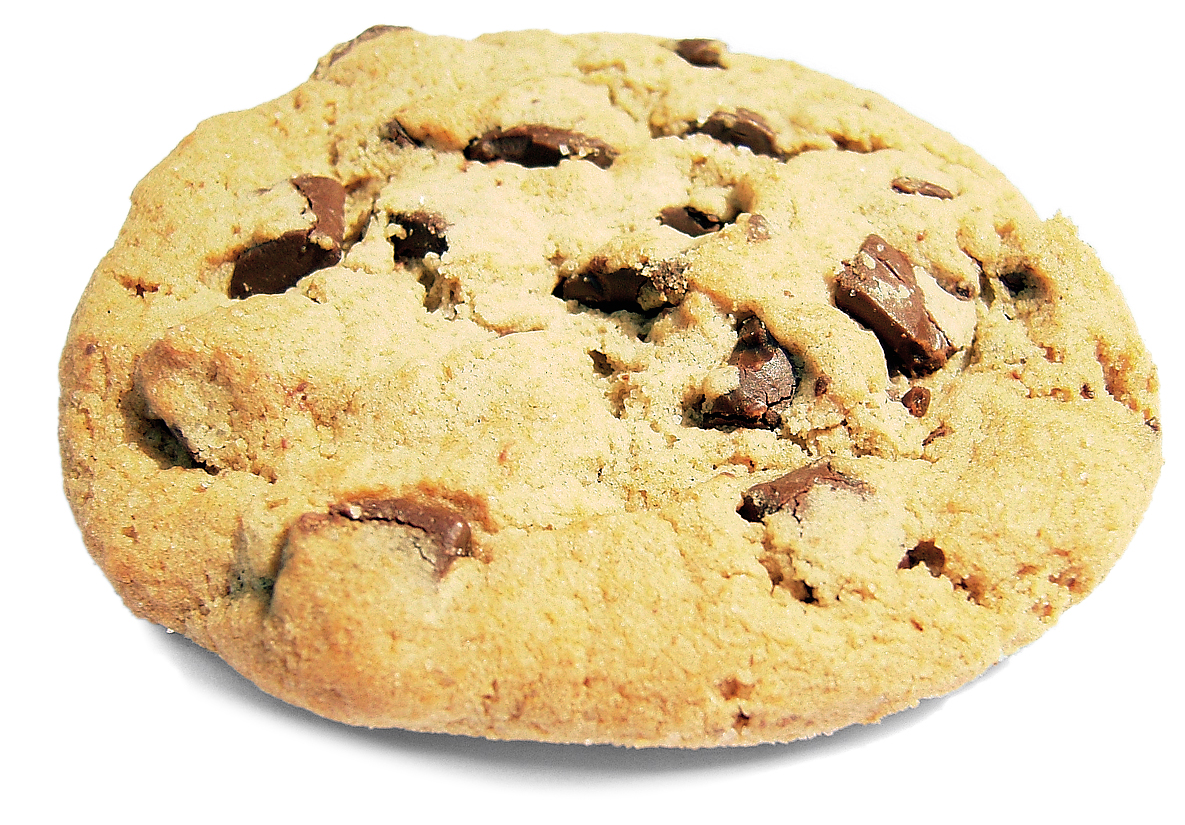
What is YOUR Perfect Cookie? Thin, Chewy, or Puffy?
This is the question that I pose to my Bakery students before watching Good Eats: Three Chips for Sister Martha. They write their answer across the top of their journal.
Three Chips for Sister Martha is a great episode to explain the science behind great cookies. My students are just coming off their basic ingredients understanding so it is nice for them to apply that knowledge right away.
Then, during the video, students take notes about what makes their cookie different from others. I ask them to compare based on sugar, dry ingredients, fat, and eggs. They compile their results into a table:
I use their responses to divide them into kitchen groups for their drop cookie lab. Incidentally, the groups ended up being really great. I may have to use this group strategy for all of my classes. :)
You can view the recipes on Food Network here:
This is the question that I pose to my Bakery students before watching Good Eats: Three Chips for Sister Martha. They write their answer across the top of their journal.
Three Chips for Sister Martha is a great episode to explain the science behind great cookies. My students are just coming off their basic ingredients understanding so it is nice for them to apply that knowledge right away.
Then, during the video, students take notes about what makes their cookie different from others. I ask them to compare based on sugar, dry ingredients, fat, and eggs. They compile their results into a table:
Fat
|
Sugar
|
Eggs
|
Dry Ingredients
| |
Thin
|
Butter has a sharp set point so it will spread quickly
|
A higher ratio of white sugar to brown sugar makes a crispy cookie
|
Eggs puff up so replace one egg with ¼ C of milk
|
All-purpose flour
Increased baking soda increases the set temperature of the cookie
|
Puffy
|
Shortening melts at a higher temperature that butter so it will not spread as far
|
Use more brown sugar than white sugar for a soft cookie
|
Use two eggs
|
Cake flour is fluffier and will rise more
Baking powder is more acidic and will rise quickly
|
Chewy
|
Melted butter will increase gluten
|
Brown sugar makes a chewy cookie because it is coated in molasses
|
Use one egg, one egg yolk, and 2 T milk because egg whites dry cookies out
|
Bread flour has more gluten which is chewy
|
I use their responses to divide them into kitchen groups for their drop cookie lab. Incidentally, the groups ended up being really great. I may have to use this group strategy for all of my classes. :)
You can view the recipes on Food Network here:
Friday, January 24, 2014
Use MyFitnessPal's Barcode Scanner in Classroom Calorie Calculation
Earlier this school year I wrote about my love for MyFitnessPal.com, especially after the not-so-conveniently timed federal government shutdown.
If you can believe it, I love this app even more today!
My Bakery students are in the throws of their Create Your Own Quickbread project and made their first draft muffin today. While the muffins baked students were to calculate unit cost, calorie count, and Healthy Kids viability.
One group was short a person so they did not want to leave their oven to go to the media center. Instead they attempted to use MyFitnessPal on their phone. A senior in my class had the app on her cell phone because she has to track her food and activity for a health class. I knew there was a way to enter recipe information on the app but I assumed it would be tedious compared to a computer.
That I was before I knew.... drum roll... that a BAR CODE SCANNER existed. No amount of capital letters and exclamation points can account for the happy dance I did around my classroom. It made calculating calories so EASY! Instead of searching... and searching... and searching for the closest ingredient, students could scan my ingredients and enter in the exact information.
I am so happy with the bar code scanner that I may be using MyFitnessPal more often in both class activities and in my personal life.
If you can believe it, I love this app even more today!
My Bakery students are in the throws of their Create Your Own Quickbread project and made their first draft muffin today. While the muffins baked students were to calculate unit cost, calorie count, and Healthy Kids viability.
One group was short a person so they did not want to leave their oven to go to the media center. Instead they attempted to use MyFitnessPal on their phone. A senior in my class had the app on her cell phone because she has to track her food and activity for a health class. I knew there was a way to enter recipe information on the app but I assumed it would be tedious compared to a computer.
That I was before I knew.... drum roll... that a BAR CODE SCANNER existed. No amount of capital letters and exclamation points can account for the happy dance I did around my classroom. It made calculating calories so EASY! Instead of searching... and searching... and searching for the closest ingredient, students could scan my ingredients and enter in the exact information.
I am so happy with the bar code scanner that I may be using MyFitnessPal more often in both class activities and in my personal life.
Friday, January 17, 2014
Healthy Kids Guidelines for Quick Breads
Today the Bakery students evaluated the nutritive value of yesterday's quick breads according to the Healthy Kids Guidelines. (View my materials HERE) An email from our school lunch director says:
"Here are the limits for Healthy kids Act items:One trouble we ran into is that Cooking Light lists only carbohydrates instead of breaking down into sugar and fiber. To calculate grams of sugar we multiplied the cups of sugar in the recipe by 200 (grams of sugar in one cup) and divided that number by twelve servings.
calories=200
fat=less than or equal to 35% of calories
trans fat=less than or equal to .5gm/serving
sodium=200mg
sugar=less than or equal to 35% of calories
must be at least 50% whole grain
I would love more muffin recipes. I only have one that meets these guidelines"
Spoiler alert! My students found that each recipe has the potential to meet the guidelines. The olive bread has a bit too much salt which can easily be eliminated. Each of the breads needs more whole grains to fit guidelines which is also an easy fix.
Next week we will collaborate with our school lunch director to create quick bread recipes of our own to be served for school breakfast.
Thursday, January 16, 2014
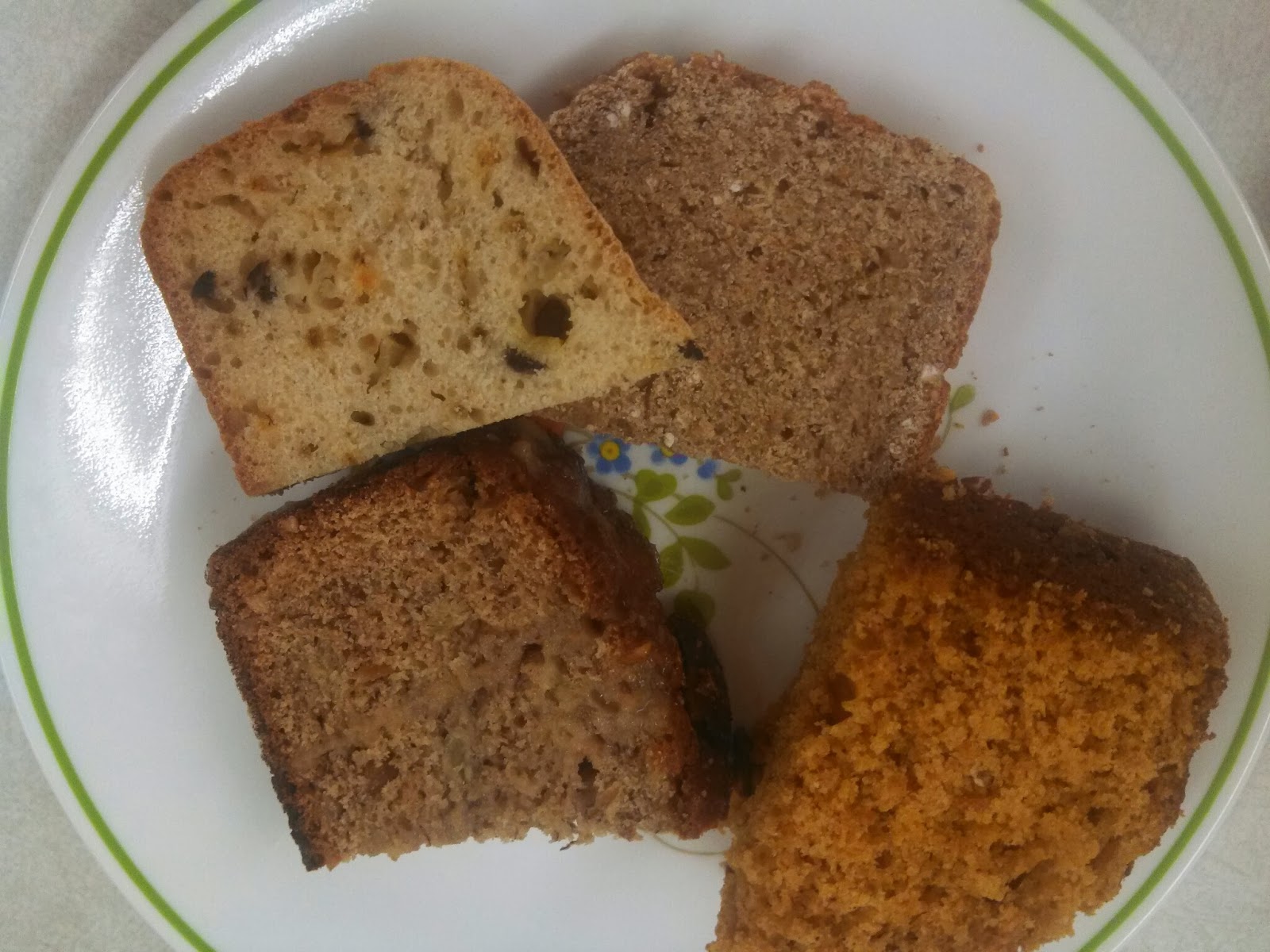
Quick Breads Lab: Four Healthy Quick Loaf Bread Options
Today my students made different types of bread to complete the blending method portion of their Basic Ingredients/Quick Breads unit.
I found these healthy (ish) recipes from Cooking Light.
- (Clockwise, from top left) Olive Bread
- Pumpkin Pecan (Students made 1/2 recipe for one full loaf)
- Brown Soda Bread
- Peanut Butter Banana Bread
Monday, January 13, 2014
Offbeat Basic Ingredients Lab: Make Seitan to Demonstrate Stretchy Gluten
We are working through the basic baking ingredients and today we spent time talking about wheat flour. Wheat is so crucial to baking because of the stretchy structure of gluten and the thickening power of starch.
To demonstrate the stretchy structure of gluten we made seitan. None of my students had ever heard of it. It is a vegetarian meat substitute of gluten simmered in a flavored broth. The resulting product can be flavored to mimic many meat dishes.
I followed this recipe from the Post Punk Kitchen to make a basic setian recipe using vital wheat gluten. While the seitan simmered my students conducted the Great Balls of Gluten experiment.
Each kitchen gets 1 C of flour and mixes in enough water to make a dough. After kneading the dough for several minutes the starch is rinsed away. The size of the resulting ball of gluten will tell the students what type of flour was used.
I panfried the setian to give it a crispy surface. I used flour and broth to make a brown gravy which demonstrated starch's thickening abilities.
The students were really cautious to try it, but said it "wasn't bad." A few kids even said it was "kinda good." To be sure, the students will not soon forget gluten's springy, spongy texture.
To demonstrate the stretchy structure of gluten we made seitan. None of my students had ever heard of it. It is a vegetarian meat substitute of gluten simmered in a flavored broth. The resulting product can be flavored to mimic many meat dishes.
I followed this recipe from the Post Punk Kitchen to make a basic setian recipe using vital wheat gluten. While the seitan simmered my students conducted the Great Balls of Gluten experiment.
Each kitchen gets 1 C of flour and mixes in enough water to make a dough. After kneading the dough for several minutes the starch is rinsed away. The size of the resulting ball of gluten will tell the students what type of flour was used.
![]() |
| L to R: Cake, pastry, all purpose, bread |
![]() |
| The seitan cutlets look just like pork chops! |
Monday, November 18, 2013
Advertising Logos and Slogans
I searched far and wide to find my favorite worksheets so that I have three each of logos and slogans.
Logos:
- Brand Alphabet Quiz (my favorite)
- Globalisation Activity (From the UK but students still recognize most brands)
- Who Am I? (PDF document)
Slogans:
I make three different worksheets, each with a logo side and slogan side. Students work individually before rotating papers with table mates.
The students have a lot of fun with this. It's amazing to see how well they do!
Thursday, November 14, 2013
Yeast Bread Activity with Modern Marvels: Bread
I like to show Modern Marvels: Bread
to my Bakery students because it gives so much historical information on bread that I could never cover. It also demonstrates sourdough and Challah, which we do not have time to make with our limited class time.
There is a fine line between teachers using videos to enhance their lesson and using videos to replace their lesson. As someone who watched Kindergarten Cop in elementary music and Field of Dreams in eighth grade health, I want to be sure that I stay on the right side of the line.
That's why I kept my students busy making bread while learning about bread. Everything in this recipe is made in a heavy-duty gallon freezer bag which means minimal mess. It is a good activity for classrooms with no real kitchens. Bread could be baked in the cafeteria ovens.
If the $20 price tag for a new DVD is too much for your department to handle, I highly suggest using Amazon instant video. This episode of Modern Marvels: Bread
cost just $1.99. Instant video is super handy when you're watching TV and think I wish I had recorded this! This is exactly what my students should know!
That's why I kept my students busy making bread while learning about bread. Everything in this recipe is made in a heavy-duty gallon freezer bag which means minimal mess. It is a good activity for classrooms with no real kitchens. Bread could be baked in the cafeteria ovens.
If the $20 price tag for a new DVD is too much for your department to handle, I highly suggest using Amazon instant video. This episode of Modern Marvels: Bread
Modern Marvels: Bread
Bread-In-A-Bag
2:45 “First, sugar, yeast, and flour are mixed with water into a one thousand pound ball called a sponge.”
In a one gallon (heavy duty) Ziploc bag, mix:
- 1/2 cup flour
- 2 teaspoons yeast
- 1/2 cup warm water
- 2 tablespoons sugar
Close bag and knead it with fingers until the ingredients are completely blended. Leave bag closed and let rest.
9:50 “Across the Kansas State Campus, in the Bakery Science Laboratory, scientists have devised dozens of tests to check the quality of flour.”
Add:
- 2 cups flour
- 3/4 cup warm water
- 1 tablespoon vegetable oil
- 2 teaspoons salt
Mix well.
Add enough flour to make a stiff dough, about 1 or 1-1/2 cups. Close the bag and knead it, adding more flour until dough no longer sticks to the bag. Leave bag closed and let rest.
20:15 “Wheat may be the basis for most bread, but corn is an American specialty.”
Preheat oven to 350 F. Place glass casserole with 4 C water on lowest rack in oven.
Spray baking sheet with cooking spray and sprinkle with cornmeal.
Turn the dough out onto lightly floured surface. Form dough into round ball, tucking seams underneath. Cut slashes in dough as demonstrated with the San Francisco sourdough. Cover with tea towel and allow to rise.
End of episode
Leaving water in place, bake bread on middle oven rack for 30 minutes or until done. Methods used to test doneness in the video include listening for crunch or tapping for a hollow sound. A sure way is to see that internal temperature is at least 205 F with an instant-read thermometer.
Friday, November 8, 2013
Yeast Bread Vocabulary Quizlet
Woo hoo! Thanks to my awesome student volunteer, yeast bread vocabulary words are up on Quizlet for my students (and you!) to use!
The words correspond with Chapter 27: Yeast Breads and Rolls of Culinary Essentials by Glencoe, 2010.
Tuesday, November 5, 2013
Create Your Own Quick Bread Project
It's that time of the Bakery term for the Create Your Own Quick Bread Project!
This activity builds on the Basic Ingredients unit. Students use a ratio formula to create their own muffin recipe. They evaluate the muffin and change their recipe based on their knowledge of ingredients.
When they have finalized a recipe they produce a finished product and "advertise" it with a 30 second or 1 minute commercial. Their commercial markets the muffin based on flavor, appearance, color, and texture, and includes a calorie count and cost-per-unit.
Students have quite the complex rubric to follow which you can download here. They just made their final products muffins yesterday and the results are delicious! Student favorites include the Pear-Walnut, Nutella Espresso, and Sweet Bacon. I look forward to watching their commercials tomorrow.
This activity builds on the Basic Ingredients unit. Students use a ratio formula to create their own muffin recipe. They evaluate the muffin and change their recipe based on their knowledge of ingredients.
When they have finalized a recipe they produce a finished product and "advertise" it with a 30 second or 1 minute commercial. Their commercial markets the muffin based on flavor, appearance, color, and texture, and includes a calorie count and cost-per-unit.
Students have quite the complex rubric to follow which you can download here. They just made their final products muffins yesterday and the results are delicious! Student favorites include the Pear-Walnut, Nutella Espresso, and Sweet Bacon. I look forward to watching their commercials tomorrow.
Thursday, October 31, 2013
Demonstrate Basic Baking Ingredients with a Simple Pancake Lab
This simple pancake lab was a nice transition between our Basic Baking Ingredients and Quick Breads unit.
Each of four kitchen groups were given the same pancake recipe but omitted a different ingredient.
Eggs,
leavening agent,liquid,
and flour.
Then I demonstrated basic quick bread method to make a standard batch of pancakes. The students compared each of the "pancake" batches to evaluate the importance of each ingredient.
You can download the recipe and reflection sheet here. I used the reflection as the assessment for the Basic Baking Ingredients unit. It makes a great foundation for the next unit when my students will create their own muffin recipe.
Subscribe to:
Posts (Atom)